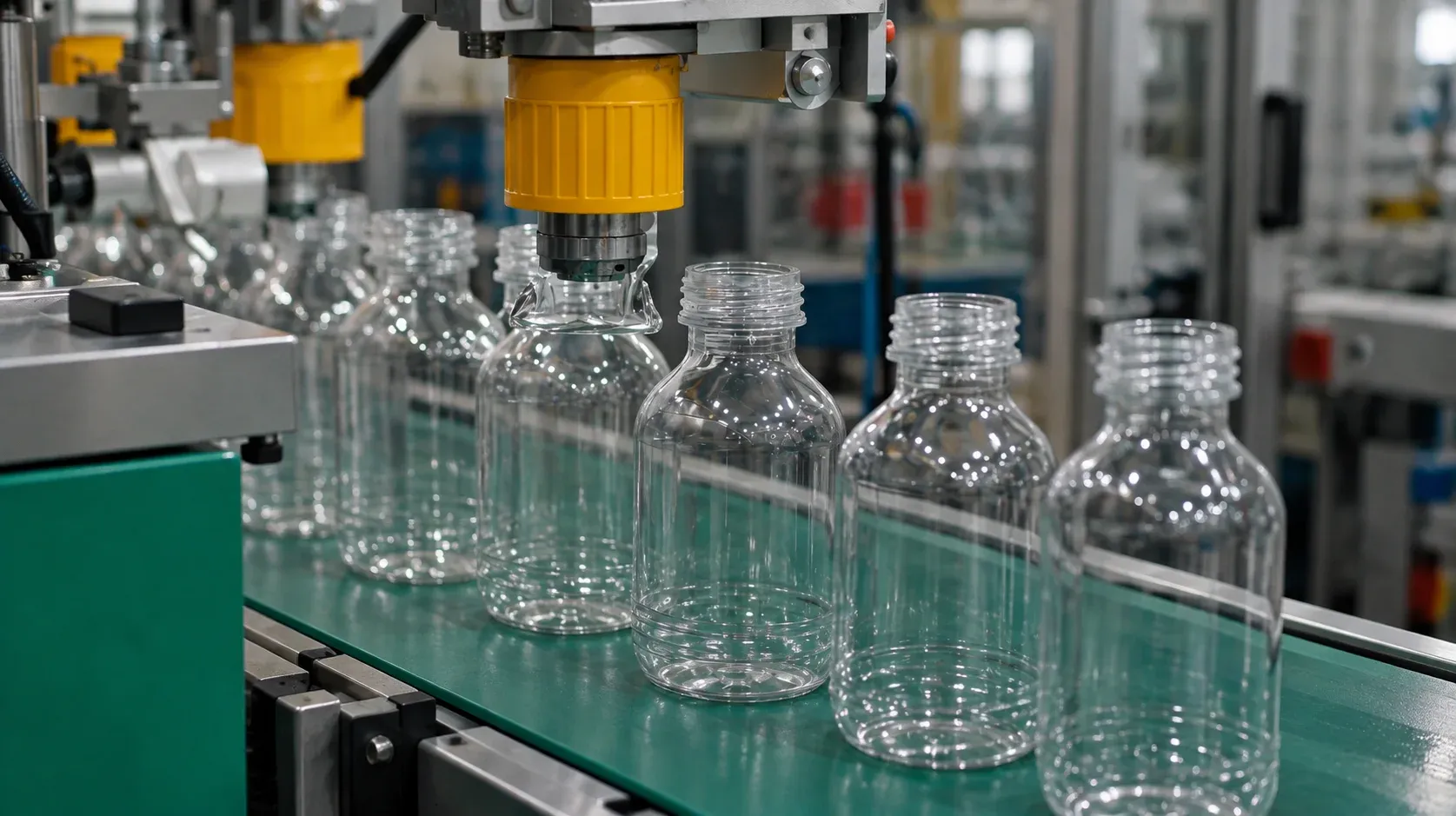
Walk onto any bottling line and you'll notice something strange: nobody's shaping bottles from scratch. They're starting from a small, thick walled tube that looks more like a test tube than packaging. That's the preform, and everything about the final bottle its strength, its clarity, how it survives a truck ride in July gets decided long before it ever touches a blow mold. If you need to assess the equipment, find suppliers, or simply understand why the supplier keeps talking about intrinsic viscosity, this paper will describe the entire manufacturing process, from resin to the final product, in simple terms.
What Is PET Preform Manufacturing?
Pet preform manufacturing is the injection molding stage where PET resin polyethylene terephthalate, the same polymer in polyester fabric gets melted and shaped into a small, precise precursor to a bottle. Picture a stubby test tube with a fully formed neck and threads already molded in, but a body that's still thick and short. That thick body isn't wasted material. It's reserve plastic, stretched and blown into the final container shape later at a separate (or sometimes integrated) blow molding stage.
Every pet bottle preform carries the genetic code of the bottle it will become. Wall thickness, weight distribution, and neck finish are all locked in during this first stage. Get it wrong here, and no amount of tweaking downstream will fix a lopsided bottle or a weak seam. That's why plant directors obsess over this step rather than treating it as a formality before the "real" bottle making begins.
PET Preform Manufacturing Process: Step by Step
1. Drying the resin. PET pellets pull moisture straight out of the air, and molding wet resin causes hydrolysis the polymer chains snap during melting, leaving brittle, hazy preforms. Resin gets dried in a desiccant hopper dryer, typically at 150–170°C for four to six hours, until moisture drops below 50 ppm. Skip this step and the defects show up downstream, where they're far more expensive to trace back. 2. Melting and plasticizing. Dried chips feed into the barrel of the machine, where a rotating screw melts them at roughly 270–290°C. The exact number depends on the resin's intrinsic viscosity (IV) higher IV grades used for carbonated drinks need slightly different thermal profiles than lower IV resin destined for still water. 3. Injection into the mold. Liquid PET is forced by high pressure into molds having multiple cavities, either 48, 72, or even 144 cavities working simultaneously on high capacity production lines. Hot runner systems ensure that the flow of resin to each cavity is uniform so that there is an equal distribution of material in all preforms. 4. Cooling and ejection. Cooling isn't passive cores are water cooled internally to pull heat out fast, since crystallization has to be controlled precisely. Too much crystallinity in the wrong zone makes the preform brittle; too little in the neck and it can't hold thread tolerances. Once solid, a robotic take out arm lifts the shot free. 5. Quality inspection. Preforms get weighed, checked for gate marks, and scanned for stress lines or acetaldehyde related odor issues before they're boxed for storage or fed directly into a blow molder.
Machines Used in PET Preform Manufacturing
A functioning line needs more than a molding press. You'll typically find: • Crystallizer dryers that condition resin (and often reprocessed regrind) before it ever reaches the hopper. • A pet preform making machine the core injection unit, sized by clamping tonnage and cavity count, ranging from compact 60 ton units for small batch runs to 500 ton plus systems for high cavity production. • Hot runner controllers that manage zone by zone temperature across dozens of gates simultaneously. • Robotic take out systems that remove parts without touching the sealing surfaces. • Vision inspection cameras for automated defect sorting.
Which pet preform injection molding machine fits your volume depends on target output, resin budget, and how many SKUs neck sizes, weights, colours you run in a week. A shop running one neck finish at huge volume wants a dedicated high cavity tool. A contract manufacturer juggling a dozen customers usually needs faster mold change capability instead.
##PET Preform Injection Molding Technology The real engineering lives in the hot runner system. Balanced flow to every cavity, down to fractions of a gram, is what keeps weight variance tight across a 96 cavity shot. Get the balance wrong and you're scrapping preforms from the "hungry" cavities while the well fed ones go on to make good bottles. Clamping force matters too undersized clamping lets the mold breathe under injection pressure, and you get flash on the parting line.
Cooling efficiency ties directly to cycle time, which ties directly to cost per part. Shave half a second off cooling and multiply it across a 96 cavity mold running continuously, and the savings compound fast. That's where investment in precision tooling pays for itself.
Comparative Analysis: Standard vs High Cavity Systems
| Parameter | Standard Injection Molding | High Cavity Specialized Preform Systems |
|---|---|---|
| Cycle Time & Throughput | 15–25 seconds per shot; lower parts per hour | 8–14 seconds per shot; built for 48–144 cavities running continuously |
| Energy Consumption per Unit | Higher kWh per preform due to smaller batch efficiency | Lower kWh per preform through servo driven clamping and optimized cooling loops |
| Dimensional Consistency & Weight Tolerance | Acceptable for general packaging, ±0.3g common | Tighter tolerance, often ±0.05g, critical for carbonated and hot fill lines |
| Mold Maintenance & Investment Cost | Lower upfront cost, simpler servicing | Higher capital outlay, but lower cost per thousand at scale |
Key Factors Affecting PET Preform Quality
Moisture control comes first it's the single most common cause of hazy or brittle parts, and it's entirely preventable with a properly maintained dryer. Acetaldehyde (AA) generation is the next headache: melt PET too hot or hold it too long in the barrel, and it breaks down into AA, a compound that gives water a faint plastic taste. Controlling barrel temperature and residence time keeps AA within acceptable limits, especially for water bottling where taste sensitivity is high.
Wall thickness concentricity matters more than most buyers realize. An off center core pin creates uneven wall distribution, and that thin spot becomes the weak point that bursts under carbonation pressure. Neck finish precision is non negotiable too a few microns of drift on the thread can mean a customer's filling line starts rejecting caps.
PET Preform Applications in Beverage Packaging
Every pet bottle preform is engineered for the liquid it will eventually hold. Carbonated soft drinks need thicker base sections to resist the internal pressure pushing outward a flat bottomed preform simply won't survive. Still water preforms can run lighter, since there's no internal pressure to fight, which is exactly where resin savings and sustainability targets meet. However, juices and hot fill applications require a shape of preform which can withstand high temperatures due to filling at 85°C+. Oil bottles care about transparency and chemical resistance rather than pressure resistance due to the different behaviour of oils in comparison with aqueous beverages.
Why Choose SEPPA Solutions for Beverage Production?
Sourcing a dependable pet preform manufacturer is only half the equation the other half is having equipment partners who understand how preform quality cascades through the whole bottling line. SEPPA Solutions supplies the injection molding systems, crystallizer dryers, and integration support beverage producers need to run consistent, low scrap production. Whether you're scaling an in house line or evaluating a pet preform making machine for the first time, an engineering partner who troubleshoots resin, mold design, and cycle optimization together rather than as separate problems saves months of trial and error.
Final Thoughts
Getting this stage of production right is less about chasing the newest machine and more about controlling the variables that actually move the needle moisture, melt temperature, cavity balance, and cooling. Nail those, and the bottles downstream mostly take care of themselves. Whether you're vetting a new pet preform manufacturer or fine tuning an existing line, those fundamentals don't change.
FAQs About PET Preform Manufacturing
1. Why is drying PET resin mandatory?
Because PET absorbs atmospheric moisture, and molding it wet causes hydrolytic degradation the polymer chains break down under heat and steam, leaving preforms brittle and often visibly hazy.
2. How do you prevent yellowing or crystallization flaws?
Keep barrel residence time short, avoid overheating the melt, and make sure cooling channels pull heat evenly from every cavity so crystallinity develops uniformly rather than in patches.
3. How can cycle time be optimized?
Balance the hot runner, tune cooling channel layout for even heat extraction, and match clamp tonnage to the actual cavity count instead of over or under sizing the press.
4. Does recycled PET ( rPET ) affect the process?
Yes the rPET may require minor modifications in terms of drying process and may affect IV levels, therefore, the machines and the formula of blending have to be re calibrated instead of a straight switch.
5. How do I choose the right equipment provider?
Look past the spec sheet. Ask about mold change turnaround, technical support responsiveness, and whether they'll help troubleshoot resin issues after the sale, not just during installation.