I've sat across the table from investors who thought building a beverage plant meant picking good machines and hiring good installers. Then, six months in, the blow molder ships two weeks late, the filler's control system doesn't talk to the conveyor the client bought elsewhere, and everyone's pointing fingers at everyone else. That's usually when someone asks why they didn't just go with turnkey projects from the start.
Fair question. Building a production facility is one of the more complicated things a business owner will sign off on, and the equipment is the easy part. The hard part is getting a dozen vendors, contractors, and inspection bodies to hit the same deadline. That's the gap turnkey projects are built to close.
What Are Turnkey Projects in Beverage Manufacturing?
A turnkey project can be described as a complete contract from inception of the first design right up to production start. From designing of the facility to fabrication of the machinery, installation, utility hookup, operator training, and commissioning all fall under the umbrella of one entity.
In contrast, the conventional approach involves the plant owner acting as his own general contractor by sourcing a filler from one supplier, a blow molder from another, packaging from yet another, and then hoping that the local integrator makes everything work together. It can work. I've seen it work. But it puts a lot of coordination risk on people who aren't usually in the business of running industrial projects.
With a genuine turnkey solution, that risk shifts to the partner equipped to manage it. You get one point of contact, one project schedule, and one company whose reputation depends on the plant actually running.
Key Components of a Complete Beverage Plant Solution
A complete beverage plant solution isn't "a bunch of machines in a building." It's interdependent systems, and missing one can stall the whole operation.
Raw Material and Water Treatment Infrastructure
Every beverage plant starts with water. Reverse osmosis, filtration, UV treatment, and mineral dosing need to match the product, whether that's mineral water or a flavoured isotonic drink.
Processing and Formulation Systems
Mixing tanks, pasteurizers, carbonation units, and blending systems turn raw ingredients into a finished, consistent product, batch after batch.
Beverage Production Equipment
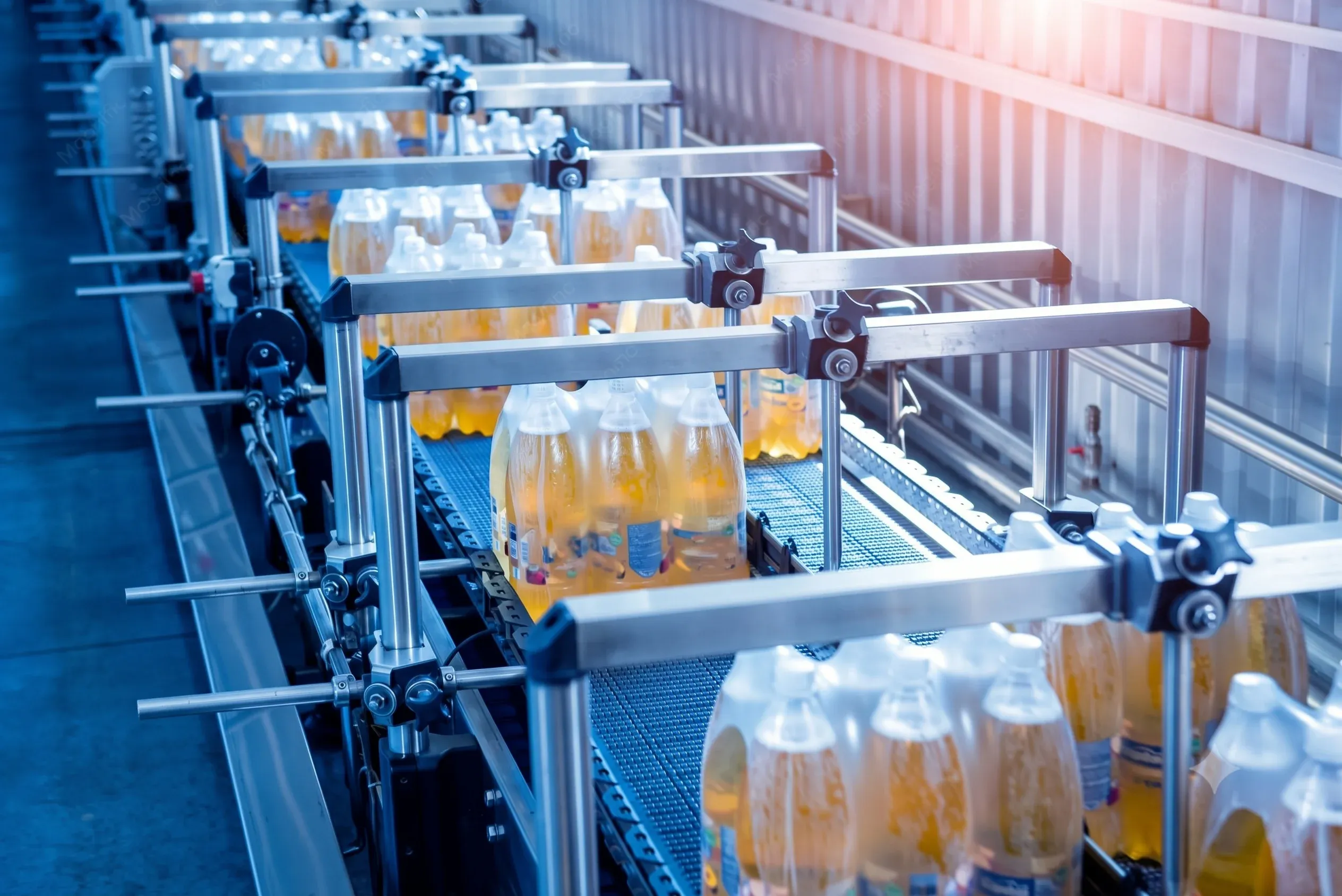
The mechanical core: blow molding machines, fillers, cappers, rinsers, labelers, and the other beverage production equipment that physically shapes and fills every container leaving the plant.
Automation and Control Architecture
PLCs, SCADA systems, and line sensors keep every machine talking to the next, so a jam at the capper doesn't send bottles crashing off the conveyor three stations down.
Packaging, Palletizing, and Warehousing
Case packers, shrink wrappers, palletizers, and the logistics layout that gets finished product from the last machine to the truck.
Skimp on automation or under spec water treatment, and even the best machines won't add up to a working plant.
How Turnkey Projects Simplify Beverage Plant Setup
Here's where the theory gets practical. On a piecemeal build, I've watched timelines slip by months, not because any one vendor was incompetent, but because nobody owned the handoffs between them. The blow molder was calibrated for a bottle neck the filler wasn't built for. The conveyor height didn't match the capper's infeed. Compliance paperwork from three countries showed up in three formats the local health authority wouldn't accept as is.
Turnkey projects remove most of that friction by design. When one engineering team specs the entire line, from raw water intake to shrink wrapped pallet, compatibility is built into the drawings before a single machine gets fabricated. Commissioning goes faster too, since the team troubleshooting a startup issue already understands every upstream and downstream system.
There's a compliance angle that doesn't get enough attention, either. Food grade material certifications, electrical codes, and sanitation standards vary by country and even by region. A partner running true turnkey projects handles that variation as routine, rather than something the plant owner has to research from scratch.
Comparative Analysis: Piecemeal Sourcing vs Turnkey Projects
Comparative Analysis: Piecemeal Sourcing vs Turnkey Projects
| Parameter | Piecemeal Sourcing (Multiple Vendors) | Comprehensive Turnkey Projects (Single Source Partner) |
|---|---|---|
| Vendor Coordination & Communication Risk | High; owner manages disputes, delays, and mismatched specs across separate contracts | Low; one contract, one accountable team, one communication channel |
| Project Timeline & Commissioning Speed | Slower, with frequent delays from handoff gaps between vendors | Faster, since design, fabrication, and installation are planned together from day one |
| Line Integration & Compatibility | Uncertain; equipment from different manufacturers may need costly rework to interface | Built in; the entire line is engineered as one integrated system |
| Initial Project Management Overhead | High; owner or a hired PM must track dozens of contracts and schedules | Lower; the turnkey partner absorbs most day-to-day project management |
The numbers on the spreadsheets usually don’t indicate how important this is until you’re the one who has to take the 6 a.m. phone call when a delivery is held up at the customs. The turnkey approach does not solve all the issues but ensures that there is only one group responsible for it.
Beverage Processing, Filling & Packaging Equipment
Equipment decisions are highly influenced by the product category. In a water bottling plant, where margins are low and volumes are everything, speed and package weight are paramount. But a juice production line is a very different sort of beast, which requires a pulp handling system, aseptic or hot fill systems, and perhaps even multiple flavour changeover areas.
A comprehensive fruit juice manufacturing facility must address the issues of variable viscosity, particulates, and shelf life stability that do not exist in a simple water line. Synchronizing all of that, from fruit intake through final case packing, is exactly where equipment mismatches surface on a multi vendor build. When the blow molder, filler, capper, and palletizer are specified by one engineering team, they run at the same rated speed instead of one machine waiting on another.
This is where flexibility earns its keep, too. Plants switching between a bottled water production line and a juice production line on the same shift need changeover built into the original design, not bolted on later.
Benefits of Turnkey Projects for Beverage Manufacturers
The most obvious benefit is speed to market. Every month a plant sits half built is lost revenue plus continued capital burn with nothing coming back. Turnkey projects compress that window by running design, fabrication, and site prep in parallel instead of sequentially.
There's a capital efficiency argument too. Piecemeal builds tend to hide costs in change orders and idle labour waiting on delayed shipments. A turnkey solution locks in scope and pricing earlier, which makes financing easier and simplifies defending ROI to a board.
Operational downtime drops as well. When one team commissions the entire line, they understand how each system depends on the next, so startup troubleshooting moves faster than with three vendors pointing at each other.
And honestly? There's a peace of mind factor hard to put a dollar figure on. Knowing there's one phone number to call, instead of a decision tree of who's responsible, changes how a plant director sleeps at night.
How to Choose the Right Turnkey Beverage Plant Partner
Not every company that says "turnkey" actually delivers on it. A few things worth checking before signing anything:
Engineering credentials and in house fabrication. Ask whether machines are built by the company or relabeled from a third party. That distinction matters for parts availability and long term support.
Track record on comparable plants. A partner who's built a bottled water production line successfully might not have the same depth on a fruit juice processing plant. Ask for references on projects like yours.
Aftermarket support. What happens eighteen months in, when a part fails at 2 a.m.? Response time and spare parts inventory matter as much as the installation itself.
Global commissioning experience. If you're building outside the partner's home market, ask how they've handled local electrical codes and import logistics before.
Why Choose Seppa Solution for Turnkey Beverage Projects?
Seppa Solution has spent years designing and fabricating beverage production equipment across CSD, juice, water, and dairy applications, which means the engineering team specifying your line has actually built lines like it before. That's not a small thing in an industry where "we'll figure it out" turns into expensive delays.
However, what really makes a true turnkey solution unique is what takes place after its commissioning rather than prior to it. Seppa Solution remains engaged through operator training, provision of spare parts, and maintenance planning services, so that plant managers do not have to cope with machinery they were not properly taught to operate. The custom manufacturing process means that the design takes into account the specific production range and space of your building.
If you are a businessman choosing between the turnkey project and piece by piece construction of the facility, this feature will be decisive for you.
FAQ About Turnkey Beverage Plant Solutions
1.How long does a typical turnkey project take from contract to first production run?
Time frames do vary, but typically, the development cycle for most of our beverages plant projects takes eight to eighteen months from signing the contract to the start of commercial operation.
2. How does a single source contract protect my investment capital?
In a turnkey solution, all scope, specifications, and prices are agreed upon up front, making change order issues non existent, while piecemeal construction can be plagued by them.
3. Can a turnkey plant handle multi flavour or multi SKU scalability?
Yes. A properly specified juice production line or bottled water production line can be designed with modular filling heads and changeover ready formats from day one, so adding flavours later doesn't mean rebuilding the line.
4. What utility requirements should I plan for before construction starts?
The water supply and quality, electricity, compressed air, and steam or thermal requirements should all be taken into account during the design process for turnkey projects because changing utilities after installation is much more expensive.
5. What does post launch maintenance typically look like?
Most comprehensive turnkey partners offer scheduled preventive maintenance, spare parts packages, and remote or on site technical support, structured around the specific beverage production equipment installed on your line.