Step foot inside any beverages processing factory, and you will be able to tell whether your machinery is helping your workforce or making their job more difficult within five minutes. Selecting the right processing line is not an easy task, which is made even harder by the fact that it is not something that you do once and forget about for a decade or two.
This article is aimed at outlining everything you need to know about industrial beverage processing lines and what goes into choosing the right piece of equipment.
What Is Industrial Beverage Processing?
The sequence of engineering transforms the combination of raw material including water, concentrates, flavours, cultures or fermenting materials into stable, marketable beverage. It is not a single machine but a series of process steps such as formulation, heat processing, carbonation or filtration, filling, capping, and packing in time with the targeted hourly production volume.
What separates a commercial beverage line from a small craft setup is repeatability. It has to hit the same fill volume, shelf life spec, and microbial safety standard on unit one and unit one million. That comes from equipment built to hygienic design standards (304 or 316L stainless steel, radiused welds, CIP compatible surfaces), not general purpose machinery adapted for food use because it was cheaper.
Types of Industrial Beverage Processing Equipment
Industrial beverage processing is really a collection of specialized systems working in sequence, each one only as good as the one feeding it.
Mixing, Blending, and Formulation
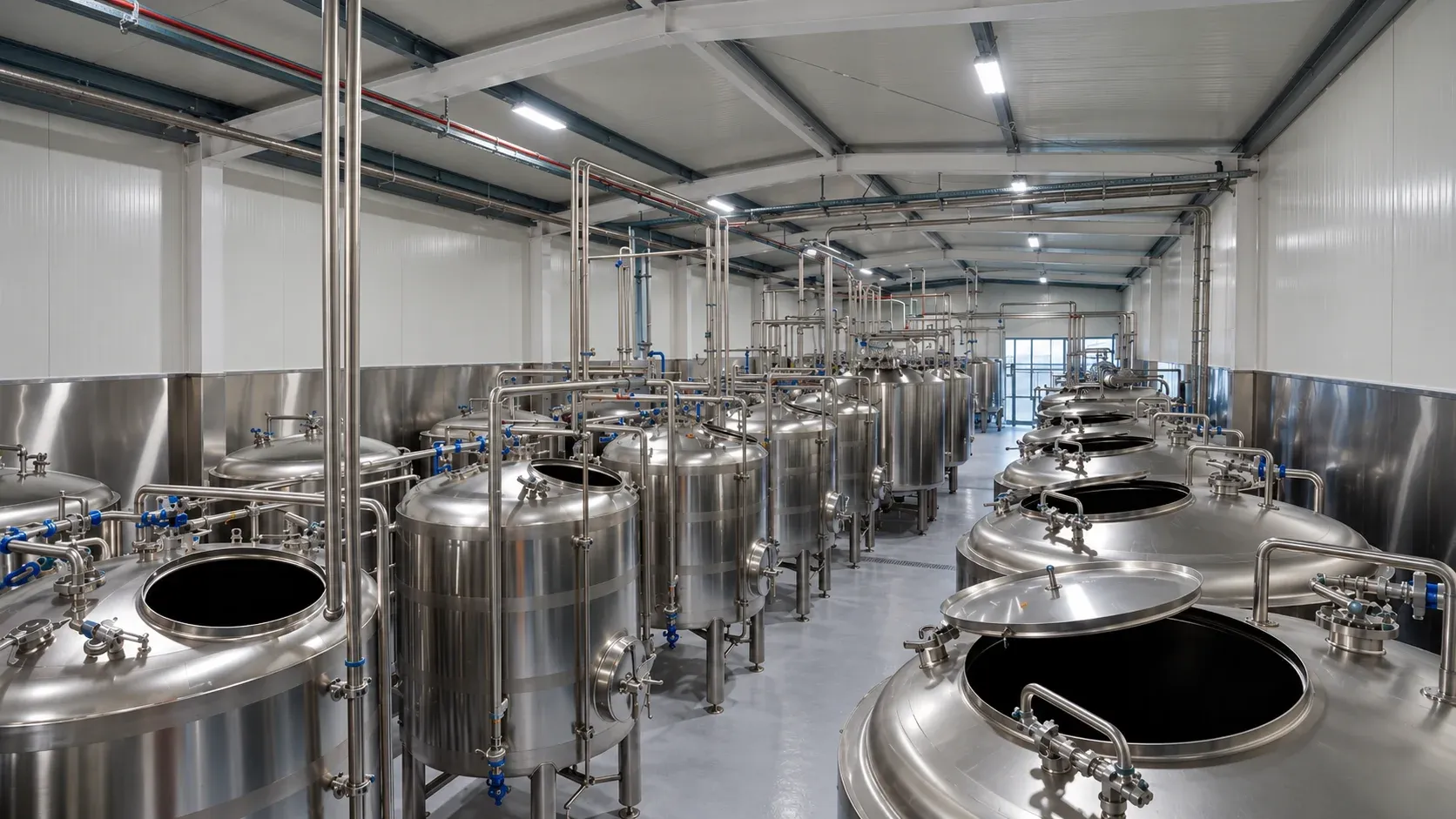
The process involves using high shear mixers and in line blenders to blend water, sugars, acids, and flavour concentrates in exact proportions according to the recipe. For carbonated drinks, carbonation is done in carbo coolers where the drink is infused with CO2. The whole process fails at the formulation stage.
Thermal Processing
Pasteurization by plate heat exchanger or tubular pasteurizer raises the product to its target temperature for a period of time, eliminating pathogens and spoilage organisms while preserving the taste. In dairy based or low acid products, there is no way around this process; it is a food safety line you simply do not cross.
Beverage Filling Equipment
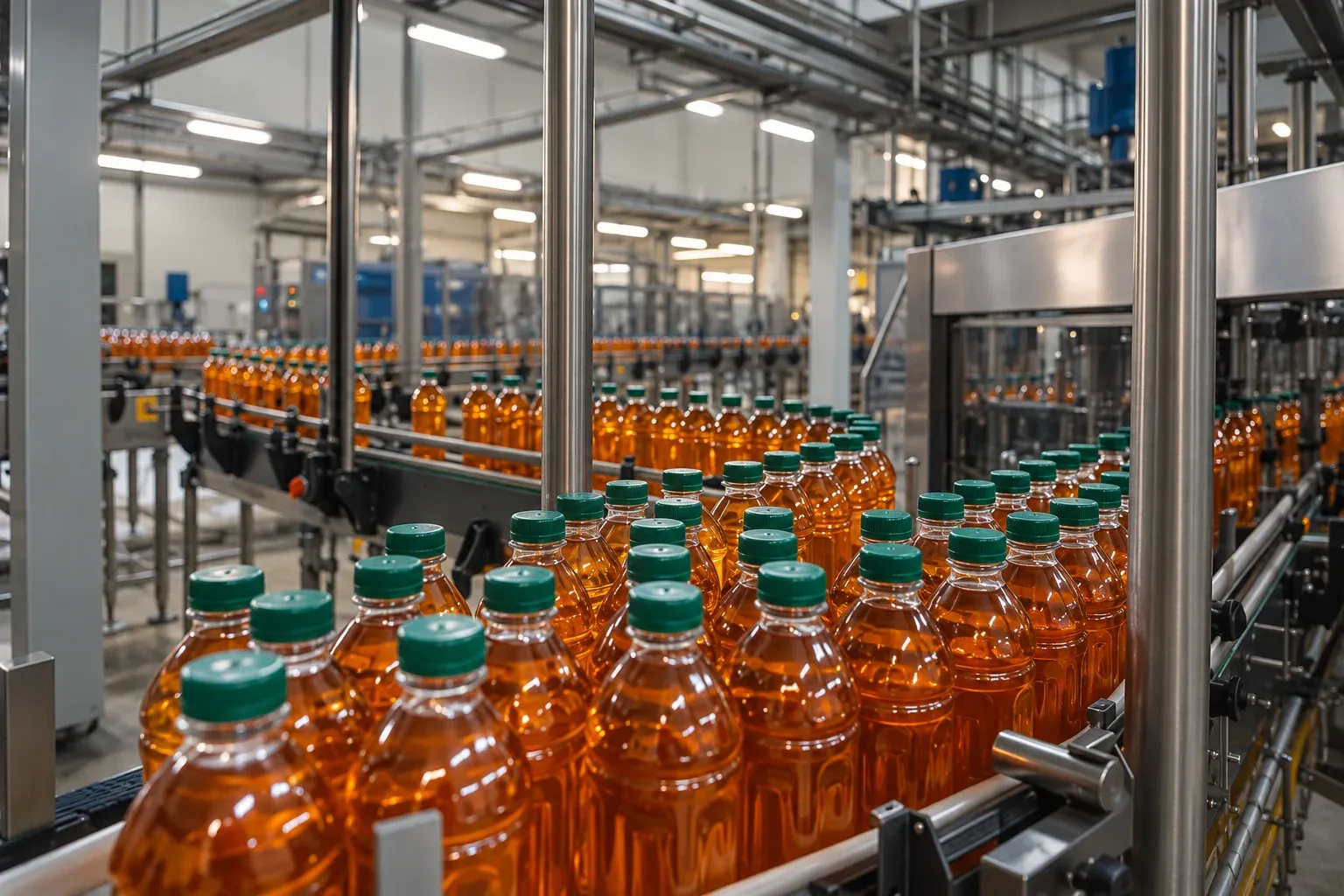
This is where most plants live or die on speed. Beverage filling equipment ranges from gravity fillers for still water to isobaric counter pressure fillers for carbonated drinks, where matching bottle pressure to line pressure prevents foaming and product loss. Volumetric and weight based fillers handle thicker products like juices with pulp or dairy blends.
Beverage Bottling Equipment
Bottling equipment covers rinsers, blow molders (for in house PET production), cappers, and labellers. Rotary rinser filler capper monoblocs show up a lot on mid to high speed lines because they cut the footprint and reduce transfer points where contamination or jams sneak in. Whatever the configuration, beverage bottling equipment needs to run at the filler's pace, or it becomes the new bottleneck.
Beverage Packaging Equipment
Once bottles or cans are filled and sealed, beverage packaging equipment takes over: case packers, shrink wrappers, palletizers, conveyor systems that move product from the filler to the warehouse without a single manual touch, at least on a well designed line.
Key Factors for Choosing Beverage Processing Machinery
Before you request a quote on new beverage machinery, get honest answers to a handful of questions. Skipping this step is how plants end up with expensive regrets.
Daily volume and growth runway. Buy for where your demand will be in three years, not just where it sits today. Undersized beverage machinery gets replaced fast, and that's an expensive lesson.
Product viscosity and characteristics. A thin isotonic drink and a pulpy mango nectar do not run happily on the same filler valve. Get this wrong and you'll be retrofitting nozzles within the first month.
Footprint and utility constraints. Rotary machines pack more output into less floor space than linear ones, but they need a bigger upfront investment and stronger utilities (compressed air, steam, chilled water) Do the math before your utility room falls short.
Material compatibility and hygiene. Acidic juices, alcohol, and CIP chemicals are hard on lesser grade metals. Confirm the wetted parts are actually rated for your specific product before you commit, not after.
Changeover flexibility. If you run multiple SKUs or bottle sizes, ask how long a format change genuinely takes not the brochure number, the real one. Every one of these factors feeds back into how smoothly the beverage manufacturing process runs day to day.
Comparative Analysis: Semi Automated vs Fully Integrated Lines
| Parameter | Entry Level Semi Automated Machinery | High Speed Fully Integrated Production Lines |
|---|---|---|
| Initial Capital Investment | Lower upfront cost; easier to finance for new or small scale producers | Higher capital outlay, but lower cost per unit at scale |
| Throughput Speed & Output | Typically 1,000–4,000 bottles per hour, operator paced | 10,000–40,000+ bottles per hour, fully synchronized |
| Labor Requirements & Operator Costs | Requires more hands on operators for loading, capping checks, and manual transfers | Minimal touchpoints; a small crew supervises rather than operates each station |
| Maintenance & CIP Automation | Manual or semi manual cleaning cycles; more downtime per changeover | Automated CIP/SIP systems with programmable recipes; less downtime overall |
Neither option is universally the "right" one, and anyone telling you otherwise is probably selling something. A beverage startup validating a new product often does fine on semi automated machinery for a year or two before graduating to a fully integrated system once volumes justify it.
How Industrial Beverage Processing Equipment Improves Production Efficiency
The real payoff of a well specified processing line shows up in numbers you don't see on the spec sheet. Synchronized automation between the filler, capper, and labeller kills off the small stoppages that quietly eat away at overall equipment effectiveness (OEE) on poorly matched lines. You notice it in the shift totals at the end of the month.
Precise dosing cuts product giveaway. An overfill of a few milliliters per bottle may not seem like a big deal until one multiplies this small number by a million bottles. Fast change, tool less changeovers enable a line to go from filling 500 ml bottles to filling 1 L bottles within thirty minutes.
This is due to the fact that all steps in a beverage manufacturing line have data collection mechanisms installed and hence plant managers are able to detect an off weight bottle fill or a weak cap torque. That's the difference between a maintenance ticket and a very bad phone call.
Beverage Processing Equipment for Different Beverage Types
Not every beverage machinery configuration fits every product, and pretending otherwise is how mismatched lines happen.
Carbonated soft drinks need isobaric fillers and carbo coolers to hold CO2 in solution through the fill. Dairy and plant based alternatives demand aseptic or extended shelf life processing, with tighter thermal control and usually homogenization upstream. Juices and nectars with pulp need wide bore valves and gentler pumps so you're not shredding texture every other shift. Spirits and high proof beverages call for explosion proof electrical ratings near the filling zone.
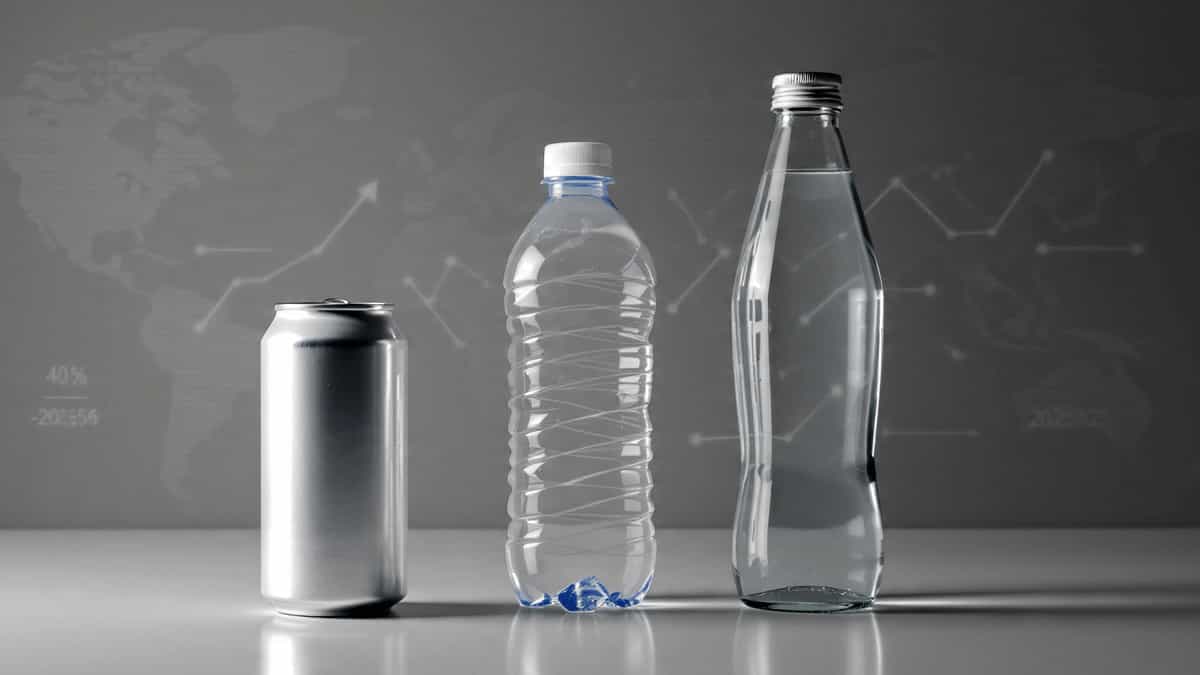
Further downstream, beverage filling machines and beverage packing machines must still be able to accommodate the type of container glass, PET, cans, pouches since they process each of these containers differently on a conveyor and at the capping station.
Why Choose SEPPA Solution for Industrial Beverage Processing?
SEPPA Solution designs and fabricates beverage machinery built around the product you're actually running, not a generic catalogue spec. The team engineers custom filling, rinsing, capping, and packaging lines, plus supporting systems like chillers and conveyors, sized to your current volume and where you plan to be in five years.
What tends to matter most to plant owners is what happens after the machine ships. SEPPA provides installation support, operator training, and long term spare parts availability, so a line doesn't end up as an orphaned asset once the warranty runs out. For producers weighing semi automated versus fully integrated systems, SEPPA's engineers can model both against your actual production targets first.
Maintenance and Safety Tips for Beverage Processing Equipment
A few habits are usually the difference between plants with high OEE and plants that are always firefighting.
• Stick to a CIP schedule, not a CIP guess. Automated cycles belong on a fixed calendar, not "whenever it looks like it needs it." • Track wear parts proactively. Filler valves, gaskets, and capper chucks have predictable service lives. Replace them on schedule, not after a failure. • Train operators on lockout tagout procedures. Beverage filling equipment involves pressurized lines, moving parts, sometimes CO2 or ammonia. This isn't a box ticking exercise. • Log every changeover. The data shows which SKUs quietly cost the most downtime, and it's rarely the one you'd guess. • Calibrate sensors quarterly. Fill weight sensors drift slowly, which is exactly why nobody catches it until it's a compliance issue.
FAQ About Industrial Beverage Processing Equipment
1. How do I calculate ROI on new beverage processing machinery?
Compare the fully loaded cost per unit labour, downtime, giveaway, maintenance on your current setup against projected costs on the new line. Divide the price difference by the monthly savings and you've got your payback period.
2. How often should preventative maintenance be scheduled?
Most plants run daily inspections, weekly CIP verification, and a deeper mechanical service every 500 – 1,000 operating hours. Your equipment manufacturer's spec sheet is the real baseline, though don't just copy a schedule from a plant running different products.
3. Can one line handle multi flavour changeovers efficiently?
Yes, if it's specified with quick release valves and programmable recipe controls. Confirm actual changeover time during equipment demos, not on paper, because paper always lies a little.
4. What power requirements should I plan for?
It depends heavily on line speed and whether you're running electric or pneumatic drives. Get a full utility spec from your equipment supplier before your electrical design is locked in, not after.
5. Can I scale a semi automated line into a fully integrated one later?
Sometimes, if the modules were specified with future integration in mind from the start. Worth raising explicitly with your equipment partner at the time of purchase retrofitting isn't always possible, and finding that out later is a rough conversation.