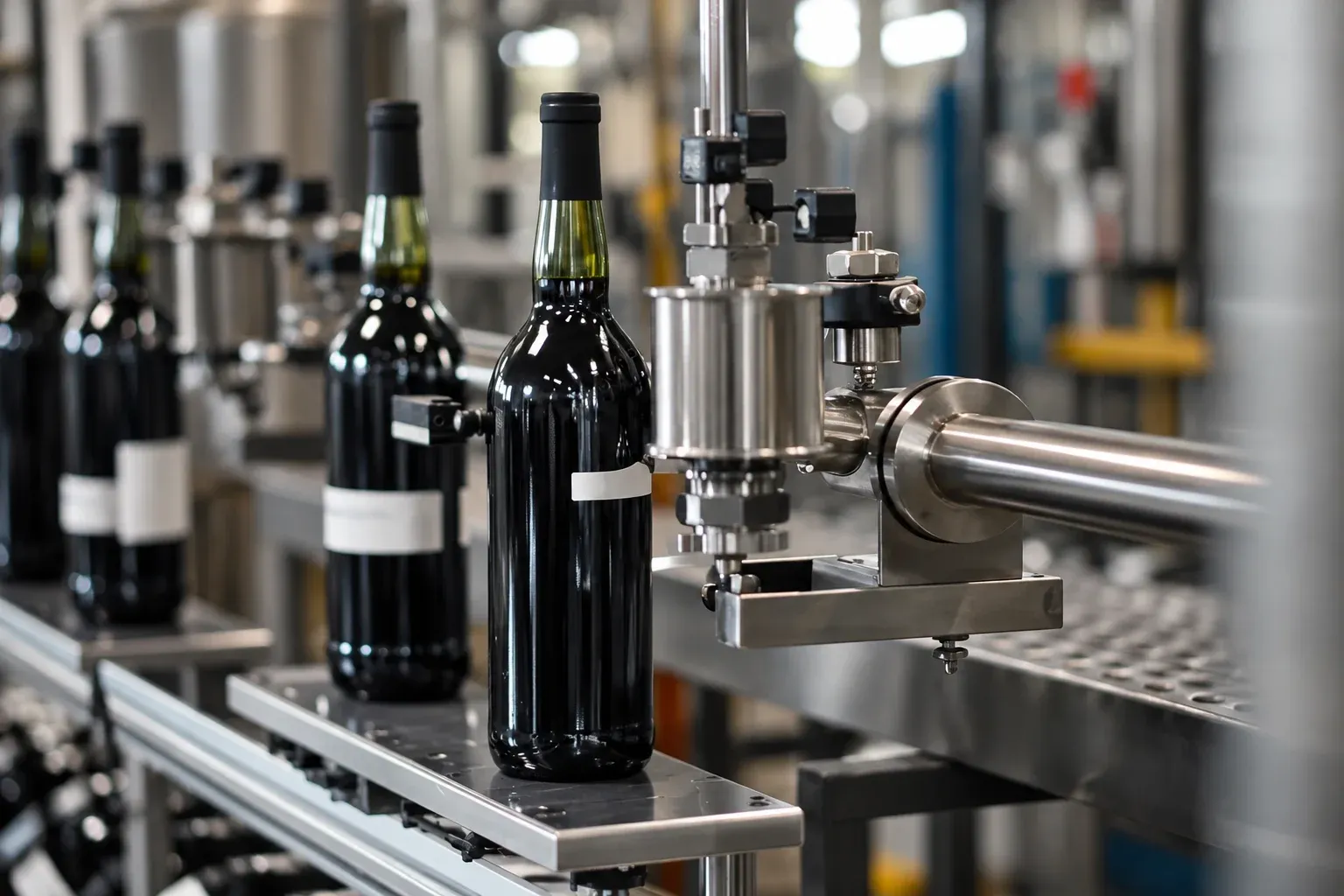
Go to any modern day bottling plant, and you will see that a hundred times a minute, a naked bottle comes in, a label is placed on it with pinpoint accuracy, and the bottle moves out ready for retailing. Nobody touches the bottle at all during the process. This is what an automatic labeller does. It is nothing but a series of sensors, motors, and time pulses that nobody pays attention to until something goes wrong. Whatever the line uses a simple bottle labeller or an industrial bottle labeller system the same principle holds true.
What Is an Automatic Labelling Machine and How Does It Work?
An automatic labelling machine is packaging equipment that applies labels to containers without a person handling each one by hand. Instead of pressing a sticker on and hoping it lines up, the machine reads each container's position as it moves and applies the label at the exact same spot, bottle after bottle.
A bottle labelling machine combines three things: motion, measurement, and timing. A sensor measures where the bottle actually sits versus where the machine expects it, and a control system fires the label at the right instant. What separates a modern automatic labelling machine from a twenty year old unit is precision older machines relied on fixed timing belts that worked only if every bottle behaved identically. Real bottles wobble, and a good bottle labeller compensates in real time, which is why so many plants replace an aging bottle labelling machine with one built around live sensor feedback.
How Does an Automatic Labelling Machine Find the Exact Spot on a Moving Bottle?
Here's the surprising part: the machine isn't guessing based on time elapsed it's watching the bottle itself. A photoelectric eye ahead of the labelling head detects a registration notch, seam line, or printed mark as the bottle passes, the trigger every automatic labelling machine relies on.
The instant that feature crosses the sensor's beam, an encoder tracks exactly how far the conveyor has moved, pulse by pulse, far more precisely than a clock could. Since speed changes are tied to the line and have no effect on positioning accuracy, this makes it different from an industrial bottle labelling machine on paper to a machine which works. The automatic labelling machine works since there is an encoder and sensor feedback and there is the servo motor that works in unison with one reference point, making sure that the label comes into place in just a fraction of a millimeter per minute.
The Technology Behind Precise Bottle Labelling
Three components do most of the work inside any well built bottle labeller, the kind worth budgeting for over a cheaper bottle labeller: the photoelectric sensor, which spots exactly where the registration feature sits; the rotary encoder, which converts motion into a signal the control system counts with extreme accuracy high frequency encoders resolve thousands of pulses per revolution, letting an automatic labelling machine stay accurate even when speed isn't steady; and the servo driven dispensing head, which releases the label at the calculated moment, adjusting on the fly rather than running on a fixed schedule.
A wiping roller smooths out trapped air on contact sense, measure, calculate, apply. Put those pieces together and you have the mechanical heart of any automatic sticker labelling machine worth the name, whether it's a compact bottle labeller or a full industrial bottle labelling machine line.
Manual Labelling vs Automatic Labelling Machines: A Side by Side Look
| Parameter | Manual / Semi Automatic Labelling | Advanced Automatic Labelling Machine |
|---|---|---|
| Speed & Throughput | 10–30 bottles per minute, limited by operator fatigue | 100–600+ bottles per minute |
| Placement Accuracy | Misalignment of several millimeters is common | Typically within ±0.5–1 mm |
| Labor & Error Rates | Dedicated staff per station; errors climb with fatigue | One operator oversees several stations; errors stay low |
| High Speed Compatibility | Becomes a bottleneck above roughly 50 bpm | Integrates directly with fillers and cappers |
Numbers like these are why plants that outgrow a manual station move straight to bottle labelling equipment built around servo control, rather than patching together another semi automatic bottle labelling maching.
From Conveyor to Finished Product: The Automatic Bottle Labelling Process
Picture one bottle entering the zone. Star wheels keep it centered, since a sideways drift here throws off everything downstream. The photoelectric sensor picks up the registration mark and hands a trigger signal to the control system, and the servo motor unwinds label stock matched to the bottle's own travel speed, so nothing stretches or bunches.
A peel plate strips the label from its backing at the leading edge, and a wiper section presses it down and works out trapped air as the bottle keeps moving. This whole sequence happens in a fraction of a second per bottle on a properly tuned industrial bottle labelling machine multiply that by hundreds of bottles a minute, and you see why well chosen bottle labelling equipment matters so much on a busy line.
Why Accurate Label Placement Matters in Beverage Production
A crooked label reads as a rushed process, fair or not, and packaging is often the only impression a brand gets before someone picks up the bottle. There's a compliance angle too: batch codes and nutritional panels need a specific readable orientation, and an automatic sticker labelling machine keeps that consistent across an entire run a detail plants running an industrial bottle labelling machine at scale can't afford to get wrong.
Investing in a reliable automatic labelling machine isn't only about looking polished it protects brand equity built over years, one placed label at a time. A dependable automatic sticker labelling machine earns that trust quietly, run after run.
How to Choose the Right Automatic Labelling Machine for Your Production Line
Start with bottle geometry: round, oval, and tapered shapes each demand different orientation methods, so match the machine to your actual lineup rather than a generic spec sheet. Think honestly about label format too wrap around, front and back, or a single panel since each asks something different of the dispensing head.
Line speed matters just as much: buy a bottle labelling machine rated above your current output so you don't need an early upgrade. Check build quality too a well built bottle labeller should run a decade with routine maintenance, so cheaper bottle labelling equipment that cuts corners on components often costs more in downtime than it saved upfront. If wrap around jobs are part of your mix, confirm the automatic sticker labelling machine option is built into the base unit, not bolted on as an afterthought.
Common Labelling Challenges and How Automatic Labelling Machines Solve Them
Air bubbles under a label are usually solved with a properly tensioned wiper that presses out air progressively. Wrinkling traces back to mismatched speed between the label web and the bottle surface, something a well tuned automatic labelling machine corrects through servo synchronization rather than a fixed ratio.
Web breakage is often a tension issue, and most machines catch a break within a fraction of a second and pause before waste piles up. Adhesive slippage usually points to the wrong adhesive for the job, not a flaw in the automatic labelling machine itself. A properly specified industrial bottle labelling machine, paired with the right stock, heads off most of this cheaper than living with a poorly matched bottle labelling machine for another year.
Frequently Asked Questions About Automatic Labelling Machines
1. What's the difference between wrap around and front and back labelling?
Wrap around applies one continuous label around the bottle's circumference; front and back places two labels on opposite faces. An automatic labelling machine can be configured for either, though the sensor setup differs, and an automatic sticker labelling machine built for both formats offers the most flexibility.
2. How often do the optical sensors need maintenance?
Clean photoelectric sensors on a regular schedule, since dust or adhesive residue dulls accuracy over time. A quick daily wipe down keeps any automatic sticker labelling machine performing at spec.
3. Can one machine handle multiple bottle shapes and label formats?
Many industrial bottle labelling machine models support quick change tooling, so operators switch sizes and formats in minutes useful bottle labelling equipment for short production runs.
4. How much energy does a bottle labelling machine typically use?
Draw varies with servo size and speed, but most bottle labelling equipment runs comparably to other mid-sized gear on the line modest next to the labour and waste it saves.
5. How long does bottle labelling equipment usually last?
With routine maintenance, a well built bottle labeller runs reliably for ten to fifteen years; sensors and servo parts are what eventually need replacing.